

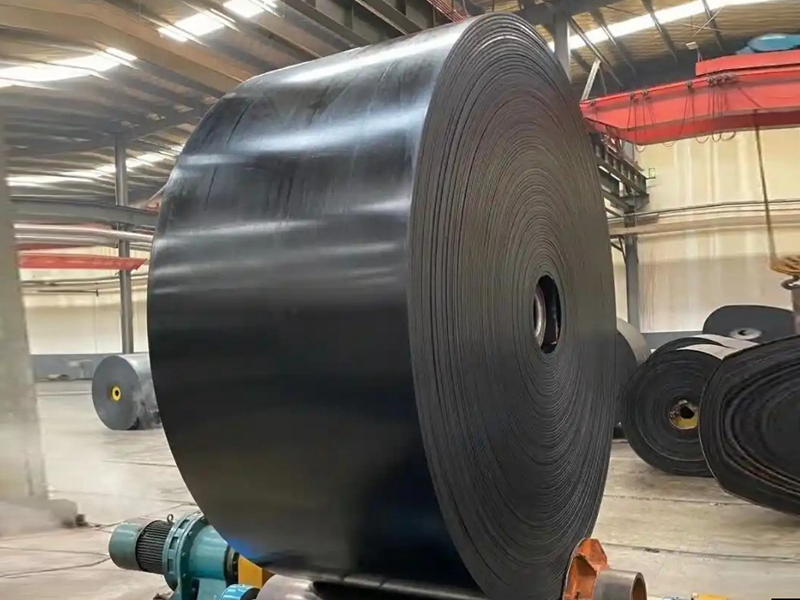
Nylon Conveying Belt Product Introduction and Technical Parameters
I. Product Core Introduction
Nylon conveyor belt (NN conveyor belt for short) is a universal conveyor belt made of nylon canvas (NN) as the skeleton material and covered with wear-resistant rubber on the surface. With its four core advantages of "high strength, high elasticity, fatigue resistance, and lightweight", it has become the mainstream choice for short distance, medium high tension material transportation in industries such as mining, coal, building materials, and grain. It can adapt to continuous transportation of scattered, granular, and block materials (such as coal, ore, grain, fertilizer, etc.), solving the problems of insufficient strength and easy stretching and deformation of traditional canvas conveyor belts.
1. Core Characteristics
Ultra strong tensile strength and elasticity: The nylon canvas skeleton has a fracture strength of up to 100-315kN/m, which is 3-5 times higher than that of ordinary cotton canvas conveyor belts. It also has a high elastic modulus and low elongation rate (static elongation rate ≤ 1.5%, dynamic elongation rate ≤ 0.5%). It is not easy to stretch or deform during operation, and can stably maintain the tension of the conveyor belt, reducing the risk of deviation.
Fatigue and impact resistance: Nylon fiber has excellent bending fatigue resistance, with a strength retention rate of ≥ 80% after 1 million bending cycles, and can adapt to long-term reciprocating operation of conveyor belts; The surface rubber layer adopts a blend formula of natural rubber and styrene butadiene rubber, with an impact strength of ≥ 15kJ/m2, which can withstand the impact of block materials (such as ore and coke) and avoid damage to the conveyor belt.
Lightweight and Low Energy Consumption:The density of nylon canvas is only 80% of polyester canvas, and the weight of the conveying belt is reduced by 15%-20% under the same specifications, and the friction resistance with the idler is smaller (friction coefficient ≤ 0.025) during operation, which is 10%-15% lower in energy consumption than polyester conveying belts with the same conveying capacity, and can reduce equipment operation costs in the long run.
Wide Adaptability:Special models such as ordinary type, flame retardant anti-static type, acid and alkali resistant type, and cold-resistant type can be customized according to the working conditions, and can adapt to a variety of environments at room temperature (-40℃-80℃); the thickness of the covering rubber can be adjusted according to the needs, to meet the conveying needs of materials with different wear degrees, and the service life is 2-3 times longer than that of ordinary cotton canvas conveying belts.
2. Application Scenarios
Mining and coal industry: transporting raw coal (particle size ≤ 300mm), washed coal, coal gangue, and iron ore (in small pieces), such as underground transfer in coal mines and surface coal preparation plant conveyor lines. Flame retardant and anti-static types can meet coal mine safety standards (MT/T 113-2019).
Building materials industry: conveying cement, sand and gravel (particle size ≤ 200mm), lime powder, ceramic raw materials, suitable for cement production lines, sand and gravel aggregate plants, and ceramic plant raw material conveying systems.
Grain and Agriculture Industry: Transporting loose grains such as wheat, corn, soybeans, rice, as well as agricultural by-products such as feed pellets and distillers' grains. The lightweight characteristics can reduce the load on conveying equipment and reduce energy consumption.
Chemical and fertilizer industry: transporting fertilizer particles (such as urea, compound fertilizer), pure alkali, salts and other non corrosive materials, acid and alkali resistant types can adapt to mild corrosive environments (pH 4-10).
Port and logistics industry: used for material transportation in bulk cargo terminals and warehouses, such as loading and unloading of coal, ore, and grain, with high elasticity to adapt to frequent start stop conditions at the terminal.
II. General Technical Parameters
The following are the core technical parameters of nylon conveyor belts (NN series), which can be customized and adjusted according to the characteristics of the material and the conveying working conditions:
|
Parameter category |
Parameter range / standard value |
Explanation |
|
Basic structural parameters |
|
|
|
Conveyor belt type |
Ordinary nylon conveyor belt (NN100-NN315), flame retardant anti-static nylon conveyor belt (NN100-NN315), acid and alkali resistant nylon conveyor belt (NN100-NN200) |
Flame retardant type is suitable for coal mines, chemical plants and other flammable and explosive scenarios; acid and alkali resistant type is suitable for lightly corrosive environment. |
|
Baseband width (B) |
500mm; 650mm; 800mm; 1000mm; 1200mm; 1400mm; 1600mm; 1800mm; 2000mm; 2200mm |
Regular width ≤ 2200mm, extra wide specifications (≥ 2400mm) can be customized, need to be matched with reinforced joints. |
|
Covering rubber type |
Natural rubber (NR) + butyl rubber (SBR) blend, chloroprene rubber (CR, acid and alkali resistant type) |
Ordinary type suitable for non-corrosive conditions; CR material resistant to acid and alkali, aging, suitable for mild corrosive environment. |
|
Covering rubber thickness |
Top cover rubber 3-15mm, bottom cover rubber 2-8mm |
Strong wear-resistant materials (such as ore, coke) select upper glue ≥8mm; light load materials (such as grain) select upper glue 3-5mm |
|
Number of canvas layers (P) |
2 layers, 3 layers, 4 layers, 5 layers, 6 layers, 7 layers, 8 layers |
The more layers, the higher the tensile strength, and it is suitable for large tension delivery. The conventional choice is 3-5 layers. |
|
Performance parameters |
|
|
|
Rated tensile strength |
NN100: 100kN/m; NN150: 150kN/m; NN200: 200kN/m; NN250: 250kN/m; NN315: 315kN/m |
Divided by canvas model, the corresponding model should be selected according to the conveying tension, and the safety factor is recommended to be 5-8 times. |
|
Delivery speed |
0.8-4.0m/s |
Bulky materials are recommended to be ≤3.0m/s, avoiding impact damage; bulk materials can be ≤4.0m/s |
|
Temperature range |
Ordinary type: -40℃-80℃; Cold-resistant type: -50℃-80℃ |
Low-temperature resistance is achieved with a low-temperature elastic rubber formula, preventing the belt from cracking in cold environments. |
|
Tear resistance |
≥25kN/m (Ordinary type); ≥30kN/m (Strengthened type) |
Strengthened with nylon short fiber to enhance the rubber layer, suitable for high impact working conditions. |
|
Flame retardant performance (flame retardant type) |
Meet GB/T 10822-2021 Flame Retardant Grade 1; meet MT/T 113-2019 standard in coal mine scene |
Oxygen index ≥ 32%, vertical burning time ≤ 30 seconds, no smoldering phenomenon |
|
Acid and alkali resistance (acid and alkali resistant type) |
pH value 4-10 (room temperature) |
After 24 hours of soaking, the tensile strength retention rate ≥75%, hardness change ≤10 Shore A |
|
Material parameters |
|
|
|
Skeleton material |
Nylon 66 Canvas (NN) |
Nylon 66 fiber is strong and wear-resistant, with a strength increase of about 15% compared to nylon 6 sails. |
|
Covering rubber Shores hardness |
60±5 Shore A (Regular); 65±5 Shore A (Durable) |
Balance abrasion resistance with elasticity to avoid material adhesion or excessive wear. |
|
Aging performance |
After 70℃×168 hours aging, the tensile strength retention rate ≥75%, the elongation retention rate ≥65%. |
Outdoor use suggestions add anti-ozonant to extend the service life in open-air environments |
Note
1. The actual selection needs to provide "material type (particle size, hardness, humidity), conveying capacity, conveying distance, tension requirements, working environment (temperature, whether there is corrosion/flammable and explosive risk)" to avoid premature damage to the conveyor belt due to mismatched models;
2.When transporting over long distances (>100m) or under high tension, it is recommended to use NN200 and above models, and to use vulcanized joints (joint strength ≥ 85% baseband strength) to reduce the risk of joint fracture;
3.When conveying materials with sharp edges and corners (such as gravel and steel slag), wear-resistant reinforced covering glue (glue ≥ 12mm) should be selected, and buffer rollers should be installed at the feeding point of the conveyor belt to reduce material impact.